

 Posts
Posts



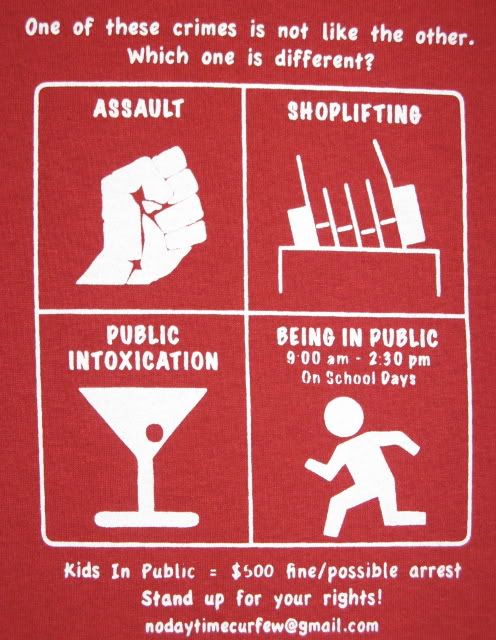
March 23, 2009 -- Approximately 70 adults and students rallied at Bedford City Hall (Bedford, TX) to protest the juvenile daytime curfew ordinance. The day marked the six-month anniversary of the Bedford city council's decision to enact the curfew on September 23, 2008.
At the same time, nearly twenty miles away, another group of protesters rallied at the Dallas City Hall, to express their opposition to an expanded daytime curfew being proposed in Dallas. The rally came two days before the first of two public hearings in Dallas on the issue.
Many of the protesters at both rallies wore "Ditch the Daytime Curfew" shirts, and waved signs that read, "Ditch the Daytime Curfew" and "Fight Crime Not Freedom." Some people even made their own signs with messages like, "Public School Parent Against the Daytime Curfew."
The twin rallies generated media attention from well over a dozen media outlets, and served to thrust the issue into the national news (ex. Wall Street Journal) with the heated controversy over the issue in Dallas.
The rallies were shining examples of what can happen when communities of people come together to make their voices heard. Some might label these demonstrations as "rebelling against government," others, myself included, prefer to use the more accurate term: citizens participating in the democratic process.
As this political battle has escalated over the previous months, it has become more and more evident that reasoned and well-researched arguments are not enough to convince these councils that curfews are neither effective nor wanted by its citizens.
Officials in both Bedford and Dallas have completely disregarded the compelling facts that show that daytime curfews are not only duplicative (state truancy laws and criminal codes already exist) and unnecessary, but curfews do absolutely nothing to solve the juvenile crime problem or underlying issues related to truancy. In fact, curfews have been shown in study after study to actually exacerbate those problems.
Additionally, daytime curfews violate parental rights to direct the activities of their children. Curfews also stifle individual freedom, and can result in civil rights lawsuits against cities which implement them inappropriately.
"We’re against the government intrusion into parental rights to dictate the activities of our own kids and the punishment of a whole community of kids . . . in a misguided attempt to catch a couple of truants," said Anne Gebhart in a Star-Telegram article which came out the day of the rally.
The curfew criminalizes children just for being in public during daytime hours, even if no crime is being committed or suspected.
Bedford Mayor Jim Story told the Star-Telegram that he does not see the ordinance as a violation of civil liberties, and said that it has been effective in keeping students in school.
According to what truancy study and numbers are you referring, Mr. Mayor? And since when does the Constitution mandate that a certain segment of the population be presumed "guilty until proven innocent"? Does our Pledge of Allegiance proclaim "liberty and justice" for only those over the age of 16? The way I see it, a law with nearly a dozen "defenses to prosecution" seems a little weak in its attempt to pose as a fair and just law.
Mayor Story was also quoted in the article as saying, "We do not feel in any way that this ordinance harasses or targets anyone in any way... All indications show this is a very good ordinance."
Feelings are not facts, and "feeling" a certain way about something does not change the facts. The fact is, the potential certainly exists for the ordinance to be used to harass and target people. This has been shown in city after city where police officers, such as those in Houston, have used the ordinance to selectively target minority areas, or waited outside school buildings to issue tickets to kids arriving late to school.
There are many examples of police officers who have overstepped their bounds and abused their discretion to cite students who were outside during curfew hours for very legitimate reasons, even reasons protected by the first amendment. You don't have to look any further than Austin, Texas:
In March 2006, high school students hit the streets in Round Rock as part of a series of nationwide immigration protests. Over 200 kids were arrested for violating the city's daytime curfew. A federal lawsuit was filed on behalf of several parents and about 50 students who claimed the arrests were unlawful.
According to Jim Harrington of Texas Civil Rights Project, "A large number of them were charged for violating the youth curfew, even though the youth curfew has an exemption in it for First Amendment activities, and of course this is a classic First Amendment activity."
Did you get that? Even though there was an exemption in the curfew ordinance for First Amendment activities, that exemption was completely disregarded by police. Here's one of many articles about the story.
Bedford Mayor Jim Story told the Star-Telegram that "being home-schooled or out with parents does not violate the ordinance."
More accurately, those situations are actually considered defenses to prosecution, Mr. Mayor, which simply means that a police officer can use his discretion to issue a citation regardless. An otherwise innocent family would then have to go to court to try to prove their defense.
Never mind that fact that there are many legitimate reasons for a teenager to be out in public during school hours even without their parent, not the least of which may include a scenario where a homeschool child is finished with their school work, or a family decides to take a vacation and the child is outside playing, or a teen drives himself/herself to work. A public school child who is exempt from exams can also be the target of this ordinance. Any minor under 17 who is outside for any reason can be a potential target.
According to the article, "Gebhart said that the way the ordinance is written, police officers have discretion as to whether or not to issue a citation. It would be up to families to fight the issue in court, which could be more of a financial burden than the $500 fine issued with the citation."
Reasoned arguments don't seem to work. Pointing out constitutionality infringments does not seem to sway those in leadership. The message the councils seem to be sending us is: "Don't confuse us with the facts."
The lesson to be learned is this: Voters far outnumber elected officials. Voters should, therefore, use their voting power to inspire their leaders to action.
Campaigns like this are won at the grass-roots level. With numbers comes power. With power comes influence. With influence comes change.
The USA is not about government dictating to the people how it does things. The USA is all about citizens holding their government officials accountable and making sure those leaders observe and protect the rights established in the constitution.
In the historic words of John Paul Jones: We have not yet begun to fight!!
Let's continue to send that message loud and clear to our elected officials while we still have the liberty to do so.
Showing posts with label truancy. Show all posts
Showing posts with label truancy. Show all posts
Sunday, March 29, 2009


Wednesday, February 4, 2009
They Meant Well
"Experience should teach us to be most on our guard to protect liberty when the Government's purposes are beneficent. [Persons] born to freedom are naturally alert to repel invasion of their liberty by evil-minded rulers. The greatest dangers to liberty lurk in insidious encroachment by men of zeal, well-meaning but without understanding."
(Justice Louis Brandeis, Olmstead vs US, 1927)
(Justice Louis Brandeis, Olmstead vs US, 1927)
Good intentions are not bad, in and of themselves; but, the means by which those intentions are accomplished can often have very unpredictable, unfavorable results which might not manifest until much later - when those original intentions are long forgotten.
As I mentioned in a previous post, I truly believe that the Bedford and Euless City Councils had good intentions when they sought to help the HEB school district with its purported truancy problem by enacting a juvenile daytime curfew at the district's request.
When the home school community spoke out against the daytime curfew, the police chiefs in both Bedford and Euless assured its citizens that it was not their intent to target home schoolers with the ordinance.
I sincerely believe them. But the councils and police chiefs simply can't speak for those who will take their place in years to come. Who knows how a restrictive ordinance, such as this one, will be interpreted or used 5, 10, or even 20 years from now?
A common phrase parroted by the police chiefs and councils is: we don't foresee a homeschool family being the target of this ordinance. We've also heard the argument that our police chief runs a tight ship and that city officials have complete faith that our officers are able to determine a real truant from a home school child.
We don't forsee.... We don't intend.... Those words are nothing more than a verbal handshake. The truth is, no matter how well-intentioned a council may be, and no matter how well-trained a police force is, there will always be mistakes. Police officers are human, and it is only reasonable to assume that an individual officer might make a human error on any given day.
There is evidence of this happening all across the state, where home schoolers have been harassed by police officers simply because they were out in public during curfew hours, even though no actual crime was being committed. And the fact that "home schooling" was among the list of defenses didn't make an ounce of difference.
I'm positive that those councils and police chiefs never intended for those unfortunate situations to happen...but when it comes right down to it, they simply have no say in how those situations involving otherwise innocent families will play out in court. Intentions are not guarantees.
The intentions of the city councils or their respective police chiefs will most likely be lost and forgotten in time. But their legacy will remain: an ordinance on the books that makes it illegal for any minor 17 years old or younger to be out in public during school hours. And the list of "defenses" will be essentially meaningless for those innocent families without the resources to defend themselves in court. When you go to court, you are automatically presumed guilty. What will it take to prove your innocence?
The law that the councils intend to use as a "strong deterrant" today, could be strictly enforced tomorrow depending on the interpretation of the city leadership to come. The letter of the law will likely prevail if the original intent cannot be established.
Ever heard of function creep? This is what occurs when an item, procedure, or process designed for a specific purpose ends up, over time, being used to serve another purpose for which it was never intended.
Case in point: the Social Security Number. Back in 1936, the stated purpose of the social security number was to facilitate record-keeping so that the proper amount of Social Security taxes were credited to a contributor's account. The government assured the public that Social Security Numbers were never intended to be used for identification purposes. In fact, each card bore the inscription, "Not for identification."
By 1961, the IRS began using Social Security Numbers for tax identification purposes. By 2002, many transactions from credit, to employment, to insurance required Social Security Numbers before they could be validated. Today, Social Security Numbers are mandatory identification, and are valued so much that criminals try to gain access to them: we call it identity theft.
What I want to emphasize is this: To have a law on the books that is broader in scope than what is necessary to address the problem at hand is simply unwise. Particularly in the case of truancy, when there are already state laws on the books to handle those specific situations.
Citizens need to speak up and use their voting power as a strong deterrant to unseat zealous leaders who don't see freedoms and civil rights as something worth defending.
Monday, February 2, 2009
The Debate Gets Heated
On December 16, 2008, the Bedford City Council held a work session, inviting the HEB-ISD and Bedford Police Chief to present their case for the juvenile daytime curfew ordinance.
Hang on a minute. The Bedford police chief helped the HEB-ISD make its case? There's something wrong with that picture.
During the work session, the police chief honestly admitted that there were no numbers to show the effectiveness or measure the impact of a daytime curfew. However, he said that he views the daytime curfew as "another tool in their tool belt" in the fight against truancy.
The school district and police chief complained that the compulsory attendance statute is too cumbersome, does not offer a strong enough deterrent, and requires too many unexcused absences before a student can be appropriately punished for truant behavior. They stated that the daytime curfew would allow them to punish a child on a first-time offense - instead of the 10 required by the state compulsory attendance law - and would allow for "intervention very, very early," before the child moves on to bigger crimes.
Did you get that? They want to inflict a fine and Class C misdemeanor charge on a child on the very first unexcused absence. Does one unexcused absence make a child truant? Not according to state truancy laws.
The district and police chief maintained that the juvenile daytime curfew would offer an immediate and strong deterrent, and would hold the parent accountable, since the curfew stipulates a fine to the parent as well as the child.
I should point out that the ordinance not only inflicts a fine of up to $500 for the child as well as the parent, but also stipulates a fine on a business owner or employee if a minor is found on the premises. Couple that with the fact that the ordinance also carries a Class C Misdemeanor charge, per offender.
What the school district and police chief are saying is that they don't want to hassle with the compulsory attendance statute. They would rather take the law into their own hands through the juvenile daytime curfew, which lays all the burden on a parent, child and business owner. The school district, on the other hand, gets to shift its statutory responsibilities onto the cities, at taxpayer expense.
If the HEB-ISD feels that 10 unexcused absences are too many, a better approach might be for the district to appeal to the Texas legislature to reduce the number of unexcused absences allowed by the compulsory attendance statute, rather than bypassing those laws by asking cities to enact another law which unfairly infringes on the rights of so many other students who have a legitimate reason to be out in public and who are not enrolled in the HEB-ISD or follow their school schedule.
A homeschool dad brought everything into perspective during the Open Forum. Using the district's own numbers, he calculated that the urgent truancy problem for which the district claimed they needed immediate action, amounted to only 1% of the total school days. The district offered no trend analysis that would indicate that truancy was a growing problem, no comparisons to other school districts, in fact no statistical data at all.
The very thing the district was so proud to announce - the difference in truancy rates since enacting the curfew - amounted to just .1 of 1% - a statistically irrelevant figure. The district had no basis to justify such a gross infringement of liberties.
The debate in Bedford was heating up.
Hang on a minute. The Bedford police chief helped the HEB-ISD make its case? There's something wrong with that picture.
During the work session, the police chief honestly admitted that there were no numbers to show the effectiveness or measure the impact of a daytime curfew. However, he said that he views the daytime curfew as "another tool in their tool belt" in the fight against truancy.
The school district and police chief complained that the compulsory attendance statute is too cumbersome, does not offer a strong enough deterrent, and requires too many unexcused absences before a student can be appropriately punished for truant behavior. They stated that the daytime curfew would allow them to punish a child on a first-time offense - instead of the 10 required by the state compulsory attendance law - and would allow for "intervention very, very early," before the child moves on to bigger crimes.
Did you get that? They want to inflict a fine and Class C misdemeanor charge on a child on the very first unexcused absence. Does one unexcused absence make a child truant? Not according to state truancy laws.
The district and police chief maintained that the juvenile daytime curfew would offer an immediate and strong deterrent, and would hold the parent accountable, since the curfew stipulates a fine to the parent as well as the child.
I should point out that the ordinance not only inflicts a fine of up to $500 for the child as well as the parent, but also stipulates a fine on a business owner or employee if a minor is found on the premises. Couple that with the fact that the ordinance also carries a Class C Misdemeanor charge, per offender.
What the school district and police chief are saying is that they don't want to hassle with the compulsory attendance statute. They would rather take the law into their own hands through the juvenile daytime curfew, which lays all the burden on a parent, child and business owner. The school district, on the other hand, gets to shift its statutory responsibilities onto the cities, at taxpayer expense.
If the HEB-ISD feels that 10 unexcused absences are too many, a better approach might be for the district to appeal to the Texas legislature to reduce the number of unexcused absences allowed by the compulsory attendance statute, rather than bypassing those laws by asking cities to enact another law which unfairly infringes on the rights of so many other students who have a legitimate reason to be out in public and who are not enrolled in the HEB-ISD or follow their school schedule.
A homeschool dad brought everything into perspective during the Open Forum. Using the district's own numbers, he calculated that the urgent truancy problem for which the district claimed they needed immediate action, amounted to only 1% of the total school days. The district offered no trend analysis that would indicate that truancy was a growing problem, no comparisons to other school districts, in fact no statistical data at all.
The very thing the district was so proud to announce - the difference in truancy rates since enacting the curfew - amounted to just .1 of 1% - a statistically irrelevant figure. The district had no basis to justify such a gross infringement of liberties.
The debate in Bedford was heating up.
Subscribe to:
Posts (Atom)